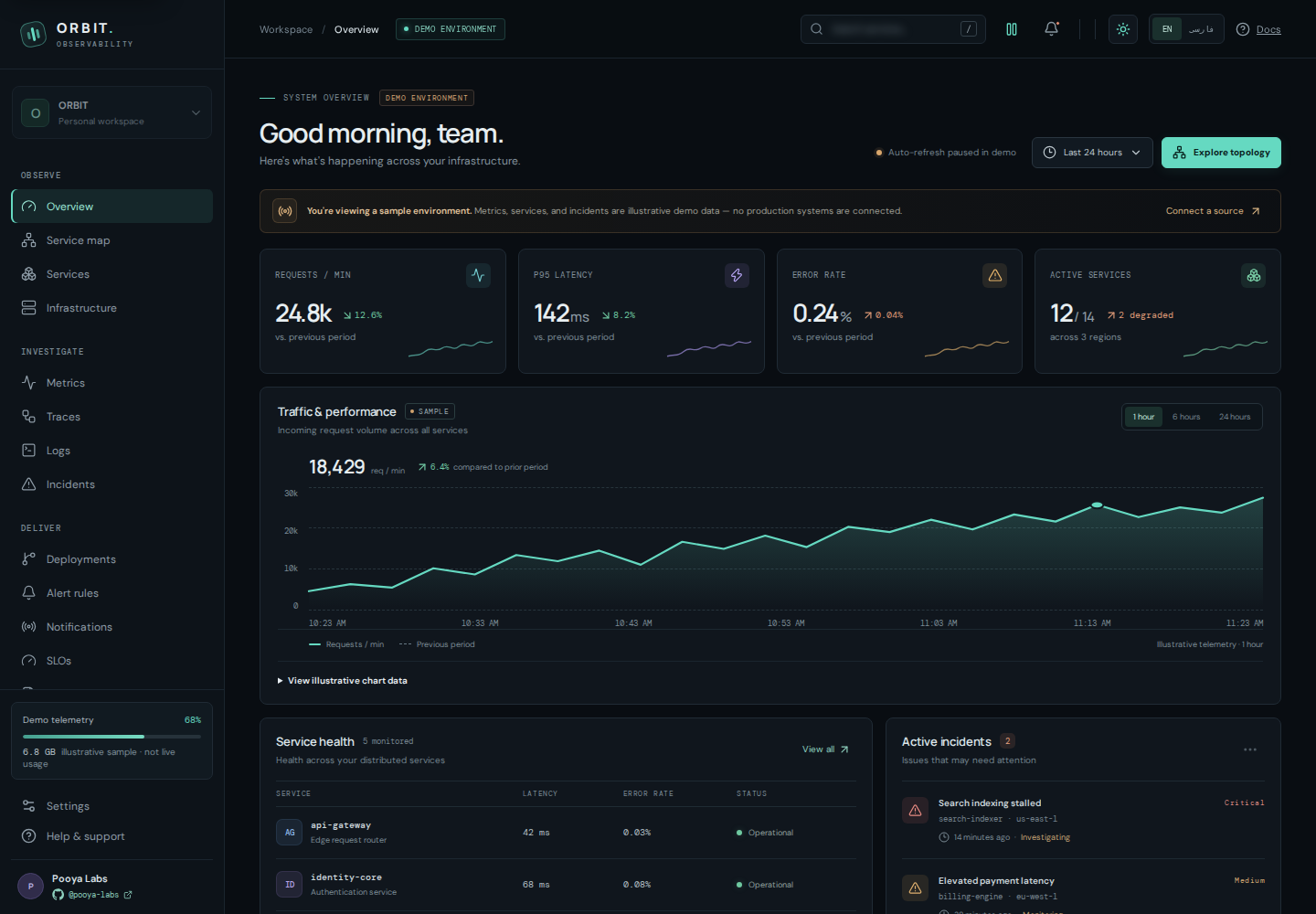
 02 / POOYA LABS
ORBIT
Stable v1.0.0An engineering workspace for service health, incidents, and operational workflows across metrics, logs, and traces. Version 1.0.0 is released for the portfolio-demo scope, not as a hosted production service.
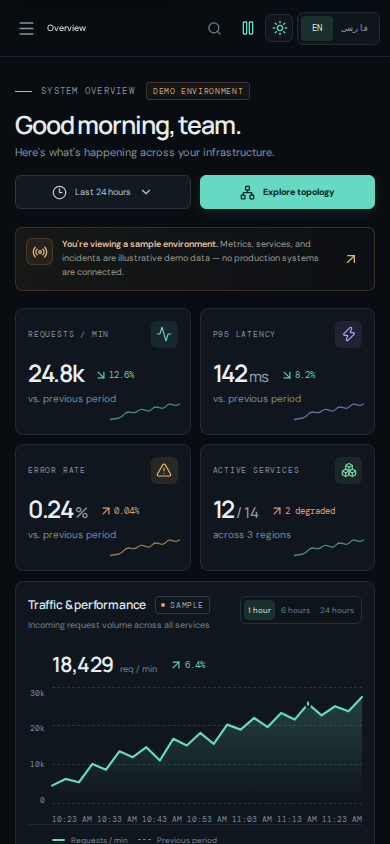
In distributed systems, service health, incidents, alerts, and metrics, logs, and traces are often scattered across tools. ORBIT brings these operational views into one cohesive workspace.
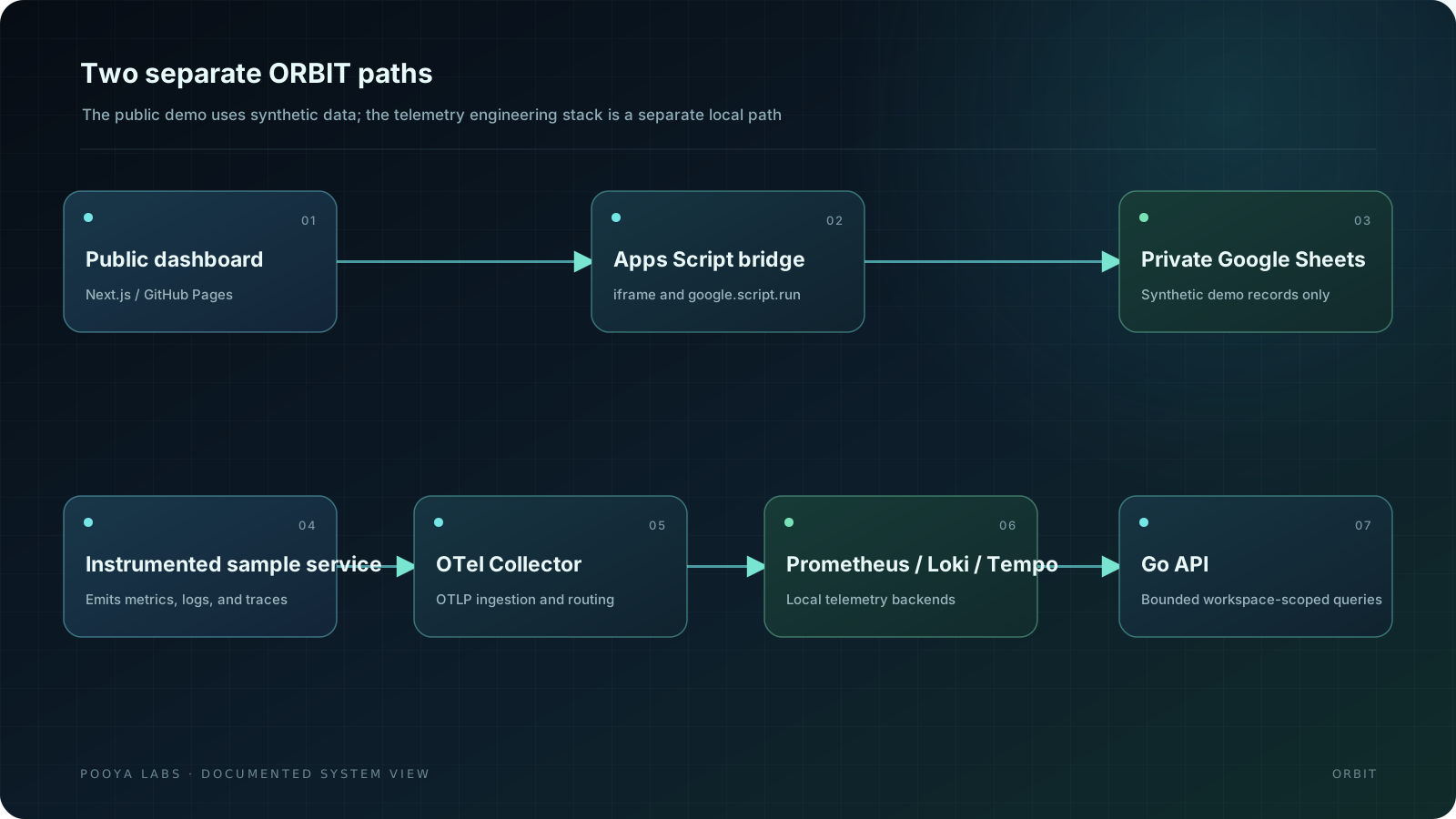
A React dashboard connects to API and data models for incidents, alerts, deployments, SLOs, audit, metrics, logs, and traces. The public demo and local engineering stack are deliberately separate.
The README identifies Pooya as project owner and maintainer.
The Next.js dashboard is static on Pages. The interactive demo uses an Apps Script Web App, fixed-origin iframe, and postMessage/google.script.run bridge, storing synthetic data in a private spreadsheet. A separate local engineering stack uses Go, PostgreSQL, and an OpenTelemetry Collector with Prometheus/Loki/Tempo.
- 01Ten views: Overview, Incidents, Alerts, Notifications, Deployments, SLOs, Audit, Metrics, Logs, and Traces.
- 02Incident lifecycle/timeline, bounded alert rules, and HTTP-success SLOs.
- 03Bounded correlated telemetry search; no arbitrary PromQL/LogQL.
- 04Persian/English, RTL, light/dark, responsive, keyboard, and chart table alternatives.
- 05CI verifies the local OTLP path and workspace A/B isolation.
- 01The public demo uses synthetic data only; notifications are simulated and send no real messages.
- 02Pages serves only the frontend; Go/Postgres/Prometheus/Loki/Tempo are not hosted production services.
- 03Redis and NATS are in Compose but application integration is deferred.
- 04v1.0.0 stabilizes the portfolio-demo scope, not a production SaaS.
- 01Stable v1.0.0 is published; release workflow, CI, Security, and Pages succeeded on the release commit.
- 02Release CI passed 4/4 jobs and Security passed 13/13; Playwright/axe and NVDA evidence is recorded.
- 03Live Apps Script bootstrap/mutation/refresh persistence need owner smoke testing; TalkBack/VoiceOver and full human review remain open.
- 01Incident lifecycle with an immutable timeline
- 02Bounded alert-rule evaluation and SLO workflows
- 03Bounded log and trace search with correlation
- 04Persian/English dashboard with accessibility considerations
- 05Stable v1.0.0 release for the portfolio-demo scope
The public demo uses synthetic data and private Google Sheets storage; the local engineering stack uses PostgreSQL and telemetry tooling. The v1.0.0 release does not mean every component is hosted as a production service.