 04 / POOYA LABS
NexusCanvas
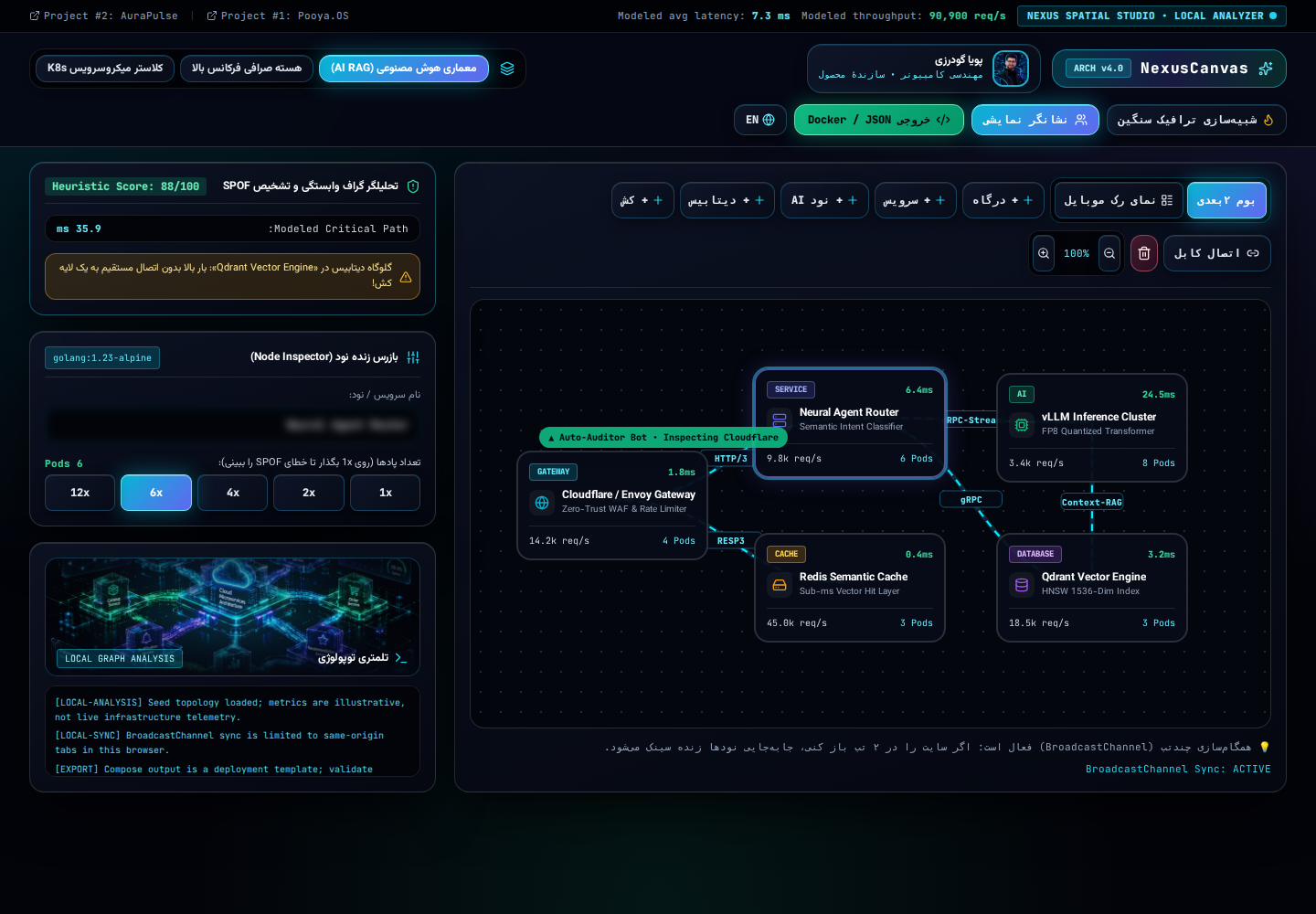
Public demoA service-topology studio for building architecture graphs, checking dependency cycles and structural risks, and exporting snapshots or Docker Compose starters. Performance values are illustrative simulations.
In system architecture, complex service relationships can hide dependency cycles, isolated services, or bottlenecks. The tool turns those structures into a visual, inspectable model.
A browser-side canvas supports node and edge editing, graph-structure analysis, a canvas/rack view switch, and versioned snapshot import/export.
The README identifies Pooya as the author.
A browser-side tool built with Next.js 16, React 19, TypeScript, Tailwind, and SVG; BroadcastChannel syncs only same-origin tabs and versioned JSON provides manual snapshot portability.
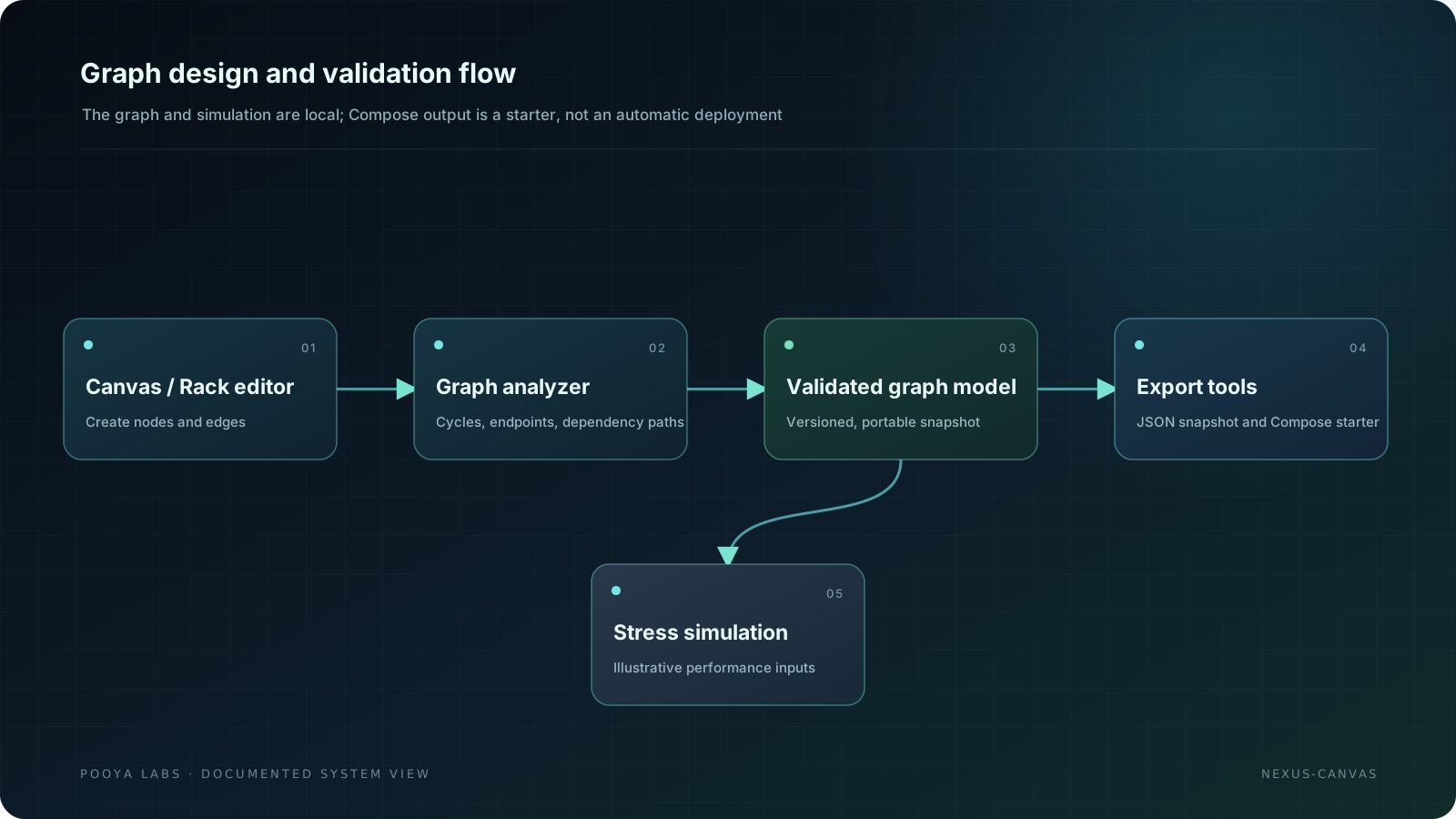
- 01Create gateways, services, AI workers, databases, and caches with dependencies.
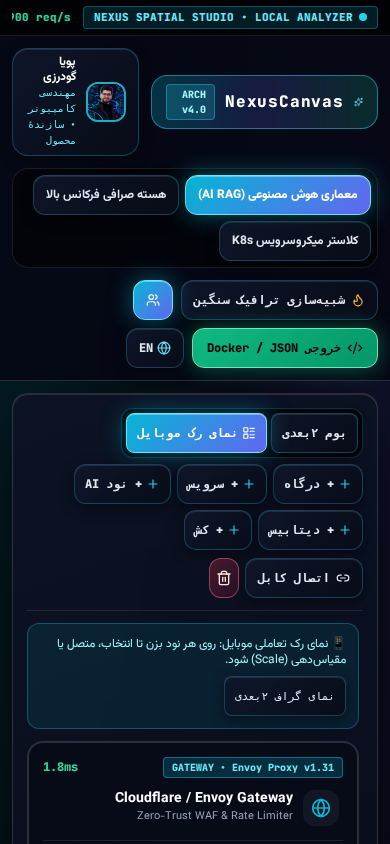
- 022D canvas and mobile-friendly rack view.
- 03Detect isolated nodes, invalid endpoints, cycles, under-replication, and modeled bottlenecks.
- 04Compute latency path only for acyclic graphs.
- 05Local 2.2× stress simulation with baseline restoration.
- 06Versioned snapshot import/export and Docker Compose starter generation.
- 01CPU/throughput/latency are simulated inputs, not real measurements.
- 02BroadcastChannel is not remote collaboration or cross-device sync.
- 03Compose output is a starter; review secrets, ports, networks, and volumes before deployment.
- 01Pages deployment for commit df05f90 succeeded on November 1, 2026.
- 02The README has no consolidated recent browser/accessibility/performance test report.
- 01Create gateways, services, AI workers, databases, and caches
- 02Detect isolated nodes, invalid endpoints, and dependency cycles
- 03Calculate longest-path latency only for acyclic graphs
- 04Validate JSON snapshots before replacing current state
- 05Generate Docker Compose starters from valid graphs
The app is client-side: it has no live infrastructure telemetry, remote collaboration, server, accounts, or shared rooms. Throughput, CPU, and latency are modeled inputs/simulations, not measurements from real containers.